Showing posts with label local eating. Show all posts

Sunday, June 12, 2011

Sweet Pea Tendril Salad


Our local farmers markets are packed of wonderful produce this time of the year. This week I bought sweet corn, super sweet orange cherry tomatoes, peppers, beets, cantaloupe, and peaches. I can't help it. When I get to the farmers market I just go a little crazy and want to buy some of everything. This week I also found pea tendrils, also called pea shoots, from one of our local farmers. Pea tendrils are the are the young leaves and shoots of the pea plant. If you've never tried pea tendrils, they are delicious. I think they taste like fresh peas crossed with spinach. You can use them in  much the same way as you would use spinach. They can be sauteed, tossed into pasta, or eaten raw in a salad.
I used the pea tendrils and several of my farmers market purchases, along with some grilled shrimp I had leftover from the night before, to make this delicious salad. I used only pea tendrils for this salad but if you like, you could also mix the pea tendrils with other salad greens.

Sweet Pea Tendril Salad with Grilled Shrimp and Corn
Serves 2 as a main course or 4 as a side salad
(printable recipe)
For the salad:
2 cups tender sweet pea tendrils or a mixture of lettuces and pea tendrils
A handful of fresh cherry tomatoes, I used tiny sweet orange tomatoes
Salt and pepper, to taste

For the corn:
2-3 ears of fresh sweet corn cut from the cob
1 Tbs. unsalted butter
1/2 tsp. kosher salt
1/2 tsp. curry powder (optional)
freshly ground black pepper

Remove the husks and the silk from the corn and cut the kernels off as close to the cob as possible without cutting into the cob. Melt the butter in a large, heavy saute pan. Add the corn, salt, pepper and curry powder, if using. Saute uncovered on medium-low heat for 8 to 10 minutes, stirring occasionally, until the corn is cooked through. Season with salt and pepper.

Lemon Vinaigrette
1/4 cup extra virgin olive oil
2 tablespoons fresh lemon juice
3/4 teaspoon minced fresh garlic
3/4 teaspoon kosher salt
freshly cracked black pepper
Gently stir the ingredients together, do not emulsify.
I used this recipe for Margarita Grilled Shrimp. I made the shrimp the night before and had it leftover. I put them on the salad cold but they would be great right off the grill on top of this salad. (If don't want to go to the trouble of grilling the shrimp, you could substitute steamed shrimp.)

Place pea tendrils in a serving bowl or divide onto individual plates. Add the tomatoes and sauteed corn and grilled shrimp and drizzle the lemon vinaigrette over the salad.
Shop at the farmers market! You not only support your local growers but you also get to eat some really tasty food.

Tuesday, April 5, 2011

Eating her curds and whey...


Back in Miss Muffet's day there were many family owned and operated dairies in the U.S. My grandfather was one of those dairy farmer's so I feel a personal connection to the dairy farmer. There has been a rapid decline in the past 20 years in family owned and operated dairies. In Alabama, my home state, 10 years ago there were approximately 200 small family run dairies. Today there are only about 60 and they are struggling hold on to their farms. There are numerous reason for the decline, but one of the major reasons for the decline is the takeover by corporate farming. These farms are strictly for money making. There is little regard for the animals or the quality of the product. The cows are fed high corn diets, attached to mechanical milkers, and pumped full of hormones, all in an effort to get the most milk for the least expense. The small farmer can't simply compete on volume and are not paid enough for their milk to keep their farms running. It's a sad situation that only we as consumers can change by supporting our local farmers. Not only will you be helping keep them in business but you will be getting a much higher quality (and healthier!) milk.
Brand new baby calf!
Sorry for getting out my soapbox, but the plight of the small farmer, is an issue near and dear to me!
I'm lucky enough to live very near Working Cow Dairy,  a certified organic milk dairy. Hubs and I visited their farm this past weekend. If I were a cow, this is where I'd want to live! The day we visited, they were offering milk buy one get one gallon free! I came home with 2 gallons of organic milk and a half gallon of organic chocolate milk.


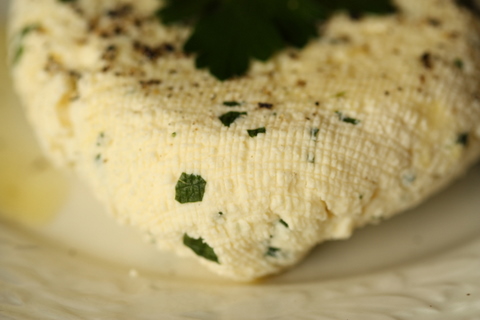
I needed to use up some of my milk so I decided to try give cheese making a try. This was a first for me so I decided to make a simple farmer's cheese. Farmer's cheese is a simple unripened cheese, similar to cottage cheese, but drier and firmer in texture. It has a mild, slightly tangy flavor and is firm enough to slice or crumble. It's an all-purpose cheese that can be eaten as is or used in cooking. I think it's great spread on fresh bread. I added flat leaf parsley and chives to mine, but it's very good just plain.

Farmer's Cheese

1/2 gallon whole milk (NOT ultra-pasteurized)
1/4 cup white vinegar
1 teaspoon salt
2 tablespoons of any fresh herb, chopped (optional)

**Note: You do not want to use ultra-pasteurized milk for cheese making because a curd will not set. Ultra-pasteurized milk is not always labeled as such, but you can tell because the expiration date is extremely long, usually 30-90 days from the day you buy it. Regular pasteurized milk, however, will work fine for cheese making. Milk from a dairy in your area will give you the best results.

Bring milk to a slow boil. Keep the heat at medium or medium low, otherwise you risk burning the milk to the bottom of the pot.
When small, foamy bubbles begin to form on the surface of the milk, but it is not yet at a rolling boil, turn off the heat. If you have a thermometer, which is helpful, the temperature will read about 190 degrees.

Add the vinegar and stir the milk. You will notice curds immediately beginning to form.

Let the milk sit for 15 minutes. After this time, add any additional flavors (like fresh herbs).
Place a colander over a large bowl or pot. Drape either cheesecloth or a thin dish towel over the colander. Pour the curds into the cheese cloth. The whey (liquid) will drain and be collected in the bowl below and the solids curds will be caught in the cheese cloth.


Parsley and chives for my cheese.

Look at those lovely curds!


Mmmmm

Lift the cheese cloth up and wrap it around the curds, twisting and squeezing to expel moisture. After squeezing out the moisture, the curds for farmer's cheese will be dry and crumbly. If you want a creamier texture, mix a little of the reserved whey back in with the curds. To shape the cheese, keep it wrapped in cheese cloth and form it into a mound on a plate. Set another plate on top and press the curds into a flat disc that is 1-2 inches tall. Cover and refrigerate for an hour or so before removing cheese cloth.


I love the pattern from the cheese cloth!

Buy local, support your local farmers!!